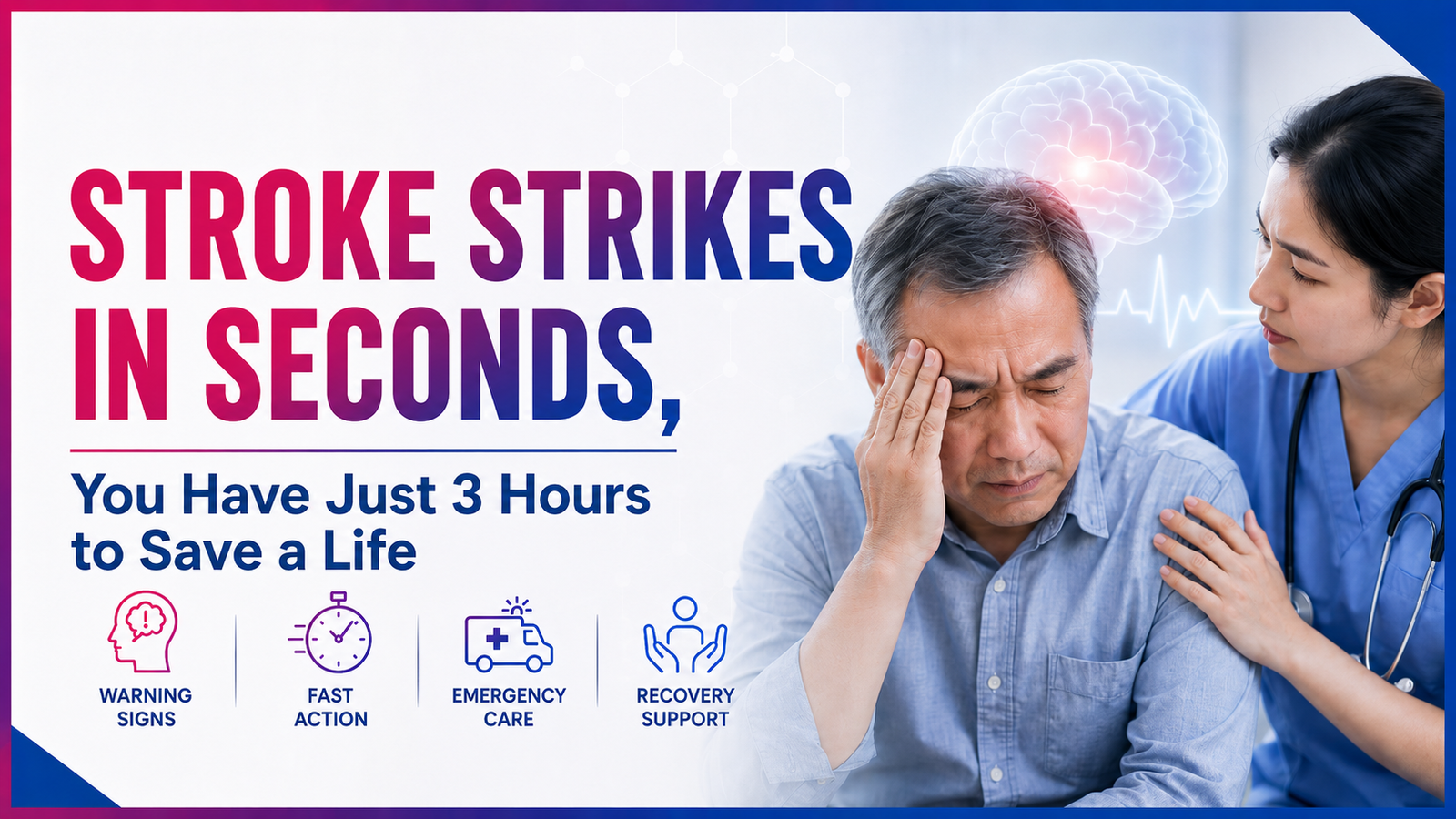
It’s usually the most ordinary moment. Someone is eating dinner, or walking back from the market, or just sitting on the sofa scrolling through their phone and suddenly something feels off. A hand drops the cup. A sentence comes out slurred. Most families don’t think “stroke” in that moment. They think the person is tired, or maybe just needs to sit down for a bit.
That hesitation is exactly what makes stroke so dangerous. It doesn’t announce itself, and the person having it is often the last one to realise something is seriously wrong.
Here’s the thing though, stroke is one of those rare emergencies where knowing what to do during a stroke in the first few minutes genuinely changes the outcome. Doctors call this the “golden hour,” and honestly, more families should know about it than currently do.
This article walks through what actually happens in the brain during a stroke, how to spot it in under a minute using the FAST test, and what to actually do while you’re waiting for help to arrive not the vague “call a doctor” advice, but real steps.
In simple terms, a stroke happens when blood stops reaching part of the brain, either because something is blocking the artery, or because a blood vessel has burst. No blood means no oxygen, and brain cells start dying within minutes. Once they’re gone, that’s it. They don’t regenerate.
There are two types, and they matter because treatment is different for each:
You can’t tell which one it is just by looking at the person, that’s why a hospital visit with scans isn’t optional, it’s the only way doctors know what treatment to actually give. This is also why stroke care almost always involves a neurology team from the very first assessment.
You’ve probably heard “golden hour” mentioned for accident victims. In stroke care, it means something similar but even more precise. The golden hour stroke treatment window is the first 60 minutes after symptoms start, the point where treatment has the best chance of preventing lasting damage.
Here’s a number that tends to stick with people once they hear it: roughly 1.9 million neurons die every minute a stroke goes untreated. That’s not a scare tactic, it’s just how fast brain tissue is affected without blood flow.
Now, the golden hour is the ideal, but in real hospital settings, doctors usually work with a slightly wider window for clot-dissolving medication, somewhere between 3 to 4.5 hours from when symptoms began. This is really what people mean when they talk about stroke treatment in first 3 hours, it’s the practical target, not the absolute ideal. Past that window, the options narrow fast, and so does the chance of a good recovery.
There’s a simple test that emergency doctors use worldwide, and it takes less time to do than it does to read about it. It’s called FAST, and if you have elderly parents or grandparents at home, this is genuinely worth memorising.
F – Face Ask them to smile. Does one side droop, or look uneven compared to the other?
A – Arms Have them raise both arms together. Does one arm sag or drift down while the other stays up?
S- Speech, Ask them to say a simple sentence out loud. Does it sound slurred, or just… off?
T – Time If any of this shows up, don’t wait around to see if it passes on its own. Call for help right away, and make a mental (or actual) note of what time the symptoms started — the treating doctor will ask.
A few other symptoms worth watching for, even outside the FAST checklist:
If even one of these shows up suddenly, it’s safer to treat it as a stroke and get moving rather than wait to see what happens.
This is the part that actually matters most in the moment, what to do during a stroke once you suspect one. In the panic, people tend to freeze or do the wrong thing, so it helps to have this in your head beforehand.
Stroke doesn’t exist in isolation, it’s connected to a wider picture of brain health that families often don’t think about until something happens. For instance, repeated small strokes over time (sometimes without obvious symptoms) are one of the recognised contributors to vascular dementia. If you’ve noticed memory lapses, confusion, or personality changes in an older family member, it’s worth reading our guide on dementia symptoms, types, causes, and treatment to understand what’s a normal part of aging and what isn’t.
It’s also worth knowing that not every sudden neurological symptom is a stroke. Persistent headaches, seizures, or gradual changes in vision, speech, or coordination can sometimes point to something else entirely, such as a brain tumor. Our article on brain tumor types, risk factors, symptoms, and treatment breaks down how these symptoms differ from a stroke and when to get it checked.
Because stroke, dementia, and tumors all fall under the same broad umbrella of brain and nervous system health, many patients end up needing input from both our neurology and neurosurgery departments, depending on what the scans reveal.
Once a patient makes it to the hospital in time, things move fast:
Some risk factors age, family history you can’t do much about. But a good chunk of stroke risk is actually within your control, and it comes down to the everyday choices most of us tend to overlook. We’ve put together a broader list of daily habits for a healthy lifestyle that goes beyond just stroke prevention, but a few habits specifically worth building are:
It’s a lot easier and far less painful, emotionally and financially, to prevent a stroke than to treat one.
For over 35 years, Rungta Hospital has been part of Rajasthan’s critical care story. We were the first private hospital in the state to introduce ICU, NICU, and even an ICU-on-wheels service. Our neurology, neurosurgery, and critical care teams work as one unit, which matters a great deal when every minute affects the outcome.
We’re also empanelled with major schemes including Chiranjeevi Swasthya Bima Yojana, RGHS, CGHS, ECHS, and ESIC, so cashless emergency treatment is available when your family needs it most.
How many hours do you have to treat a stroke?
The best outcomes come from treatment within the first 60 minutes, the golden hour. That said, clot-busting medication can still work up to 3–4.5 hours after symptoms begin in many cases. After that, options get limited fairly quickly.
Can a mini-stroke (TIA) be ignored if the symptoms go away on their own?
No, and this trips up a lot of families. A TIA often resolves within minutes, but it’s usually a warning that a more serious stroke could follow. It needs a doctor’s evaluation regardless.
Is stroke connected to conditions like dementia or brain tumors?
Stroke, dementia, and brain tumors are all part of the same broader area of brain health, and they can sometimes share symptoms. Repeated small strokes can contribute to vascular dementia over time, while some tumor symptoms can look deceptively similar to stroke symptoms, which is why proper scans and evaluation matter.
What should I do while waiting for the ambulance?
Stay with them, keep them calm, note the time symptoms started, keep the head slightly raised, and don’t give them anything to eat, drink, or take any medication.
If you notice any of these signs in yourself or someone around you, don’t wait it out. Call for help immediately. Rungta Hospital’s neurology and critical care teams are available 24/7 for exactly this kind of emergency.
Emergency Contact: +91-8955000333 Book an Appointment: rungtahospital.com/book-an-appointment