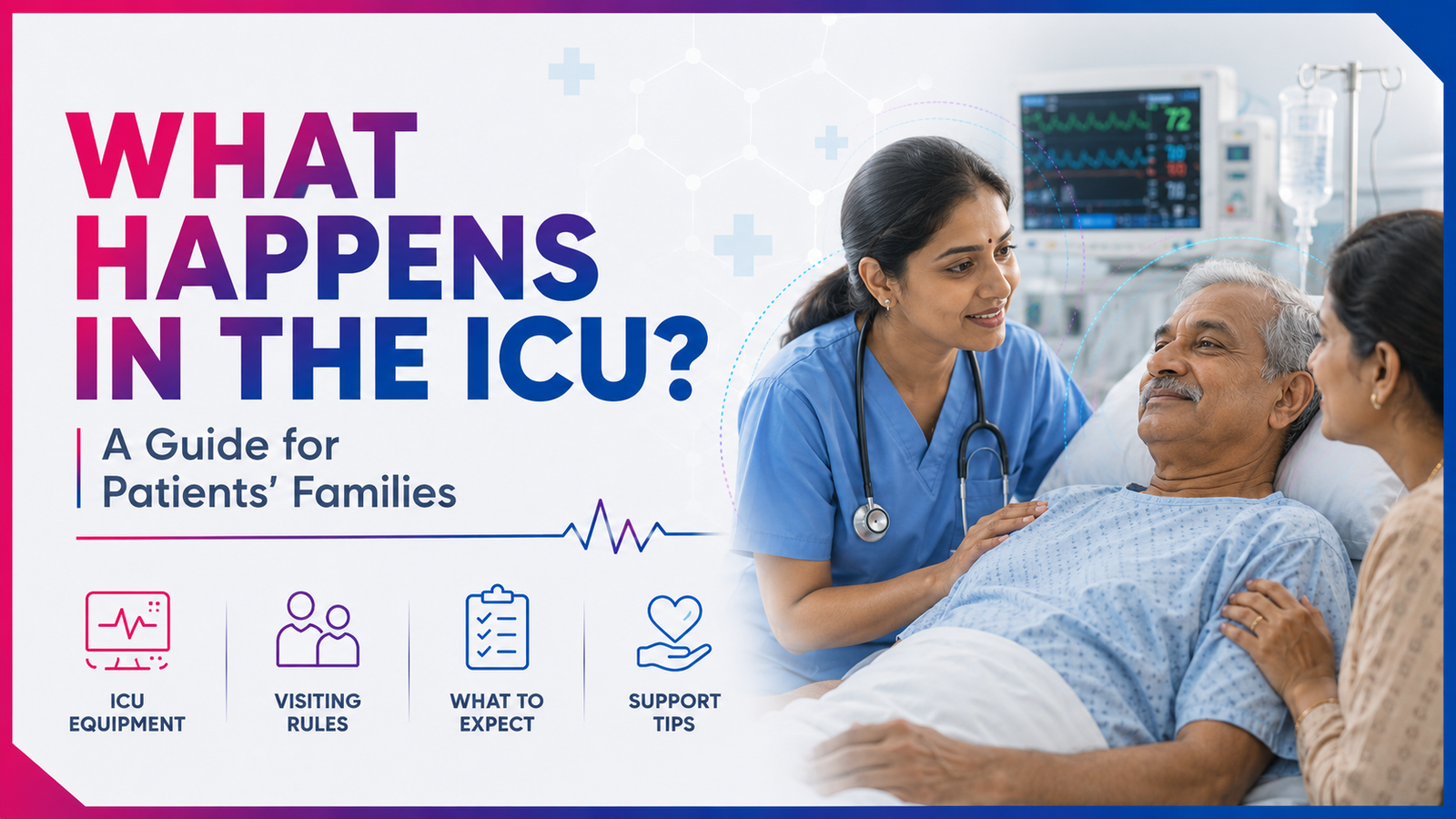
The call usually comes without warning. A doctor says the words “we’re shifting them to the ICU,” and suddenly a family that was worried a minute ago is now frightened. Not because anyone has explained what’s actually going on, but because the word ICU itself carries so much weight.
Most families walk into that corridor for the first time not knowing what to expect. The glass doors, the buzzing machines, the strict visiting slots, it all feels designed to keep you out rather than help your loved one.
It isn’t. Every rule in the ICU exists for a reason, and once you understand what happens in the ICU, the whole experience becomes a little less frightening and a lot more manageable. This ICU guide for families walks through exactly that, what the ICU is for, what the equipment around the bed actually does, how visiting works, and how you can support your loved one even when you can only see them for a few minutes a day.
The Intensive Care Unit, also called Critical Care, is the part of the hospital built for patients whose condition needs to be watched every minute, not just checked in on a few times a day. It isn’t reserved only for the most severe cases either, patients recovering from major surgery, a serious infection, a heart attack, a stroke, or a bad accident are often moved here purely as a precaution, so any change in their condition is caught the moment it happens.
The core idea behind critical care is simple: give the body the support it needs, whether that’s help breathing, medication delivered continuously, or close observation of the heart and kidneys, so it has the best possible chance to stabilise and recover. Patients recovering from procedures like heart bypass surgery, for instance, often spend a short, planned stay in the ICU simply so the heart can be monitored closely in the first day or two.
Families often ask why the rules feel so much stricter here than on a regular floor. The ICU vs general ward difference comes down to a few things:
None of this is about restricting families for the sake of it. It’s what allows the ICU team to catch small changes before they become emergencies.
Nothing quite prepares you for the first walk-in. Here’s roughly what to expect when a loved one is in ICU, so it feels a little less alarming:
If something you see looks concerning, ask the nurse on duty. ICU staff are used to explaining this to families, and a two-minute conversation can ease a lot of unnecessary worry.
The machines are often the scariest part for families, mostly because nobody explains what they do. Here’s a simple breakdown, with the ICU monitoring equipment explained in everyday terms:
Every wire and screen is there to give the medical team real-time information, not to alarm the family standing beside the bed.
Because infection control and patient rest matter so much here, ICU visiting rules for family tend to be far stricter than what you’re used to on a general ward. While the exact policy varies slightly by hospital, most ICUs follow something similar to this:
It helps enormously to decide early on who that one contact person will be. It keeps communication with the treating doctor clear, and it means the rest of the family isn’t left piecing together information secondhand.
Even when a patient seems unresponsive or sedated, hearing is often one of the last senses to be affected, and many patients can hear and register what’s said around them, even if they can’t respond. A few things to keep in mind on how to talk to an ICU patient:
Even a brief, steady presence by the bed can mean more to a patient than families realise.
The only reliable way to confirm typhoid is through a blood test. Doctors typically use the Widal test, a Typhidot test, or a blood culture, with blood culture generally considered the most accurate, especially in the first week of illness. Viral fever, by contrast, doesn’t usually need a specific test, it’s often diagnosed by ruling out bacterial infections like typhoid once the fever crosses a few days without improving.
A shift out of the ICU and onto a general ward usually happens once vital signs have stabilised, ventilator or intensive monitoring support is no longer required, and the treating doctor is confident the patient can recover safely with a lower level of care. For most families, this transition is the first real sign that things are heading in the right direction. If the ICU stay followed an emergency like a heart attack or a stroke, the doctor will usually also guide the family on what recovery and follow-up care looks like once the patient is home.
For over 35 years, Rungta Hospital has been part of Rajasthan’s critical care story. We were the first private hospital in the state to introduce ICU, NICU, and even an ICU-on-wheels service, and our Critical Care team works closely with specialists across Cardiology, Neurology, and General Medicine to manage patients as one coordinated unit, not in isolation.
We’re also empanelled with major schemes including Chiranjeevi Swasthya Bima Yojana, RGHS, CGHS, ECHS, and ESIC, so cashless critical care treatment is available when your family needs it most.
If a fever crosses the three-to-four-day mark, especially with stomach discomfort or unusual fatigue, don’t wait it out at home hoping it’s “just viral.” A simple blood test can settle the confusion quickly, and starting treatment early makes typhoid a much easier illness to manage.
If you or a family member has a fever that isn’t following the usual viral pattern, book an appointment with our doctors and get it checked properly rather than guessing.
Can ICU patients hear what family members say to them?
In many cases, yes. Hearing is often one of the last senses affected by sedation, so even unresponsive patients may register a familiar voice. Speaking calmly and briefly is always encouraged.
Why are ICU visiting hours so short compared to general wards?
Short, controlled visits reduce infection risk and give patients the rest they need to recover. It isn’t about restricting families, it’s part of how critical care protects vulnerable patients.
Does being on a ventilator mean the patient’s condition is critical or hopeless?
Not necessarily. A ventilator simply supports or takes over breathing while the body recovers. Many patients are gradually weaned off it as their condition improves.
How do I get regular updates on a loved one’s condition without disturbing the ICU team?
Most hospitals recommend designating one family member as the main contact, who receives scheduled updates from the treating doctor at a fixed time each day.